Classical favorites
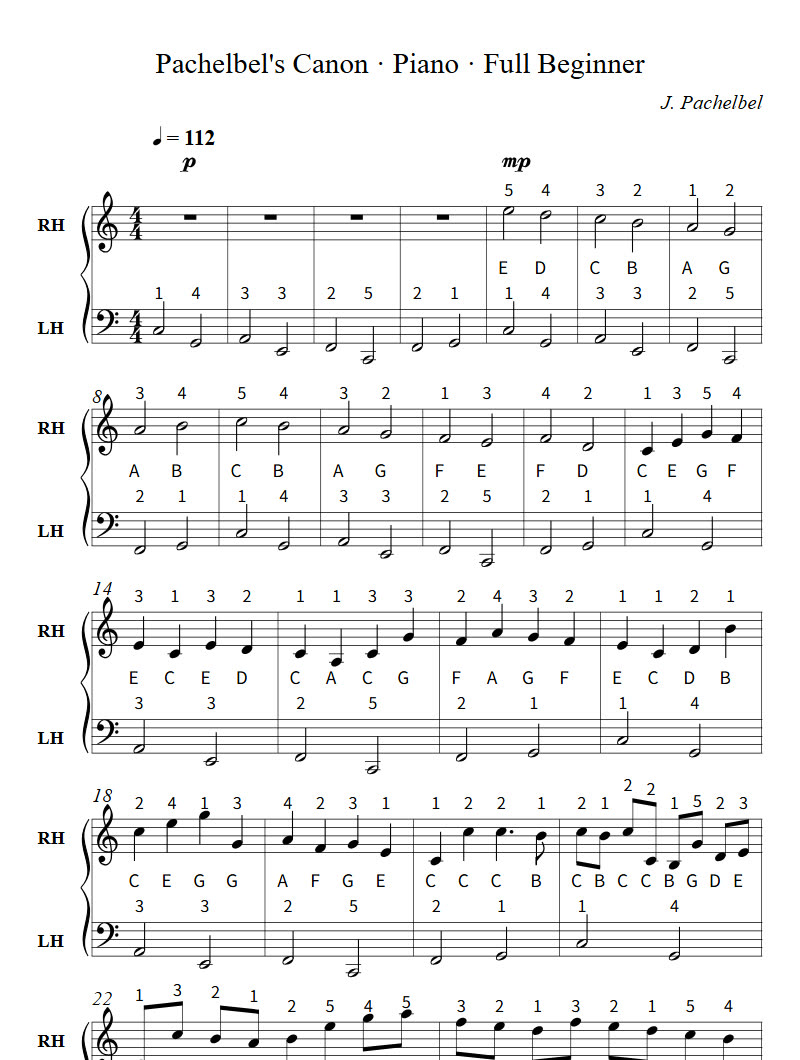 J. Pachelbel (1653–1706)
Canon in D
The most-played piece at weddings and school concerts. Layer after layer of melody builds over the same eight chords.
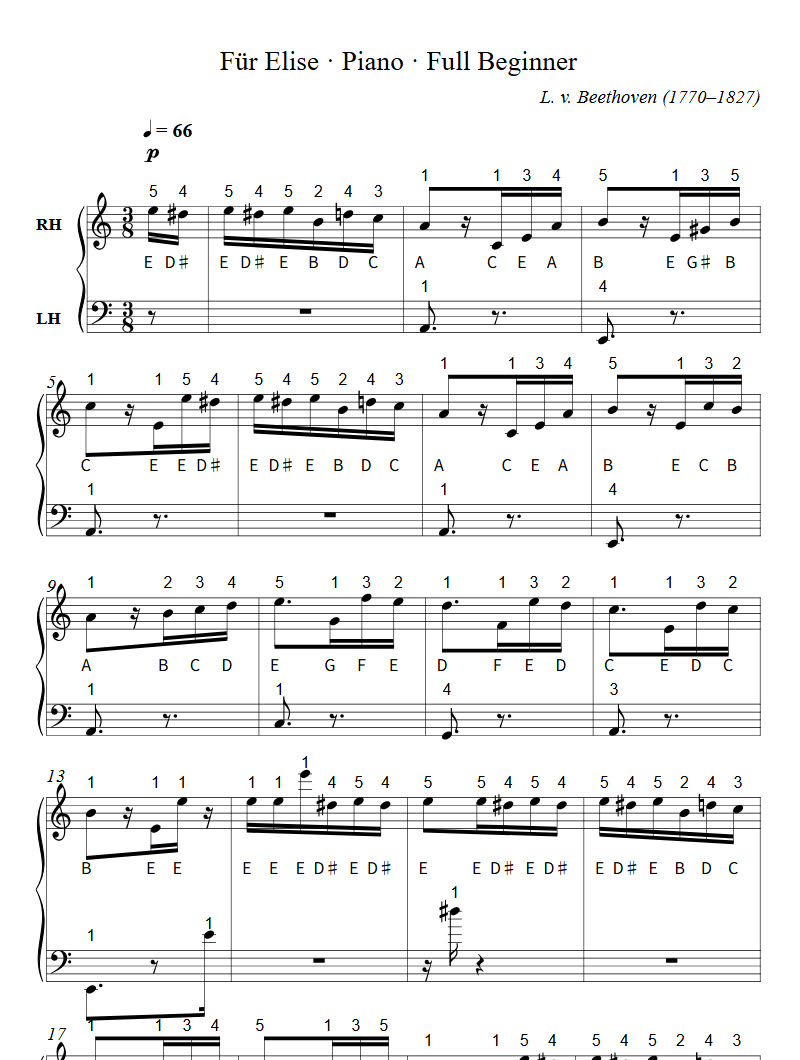 L. v. Beethoven (1770–1827)
Für Elise
The first piece many piano students reach for. Learn the opening E–D♯–E line and you're halfway there.
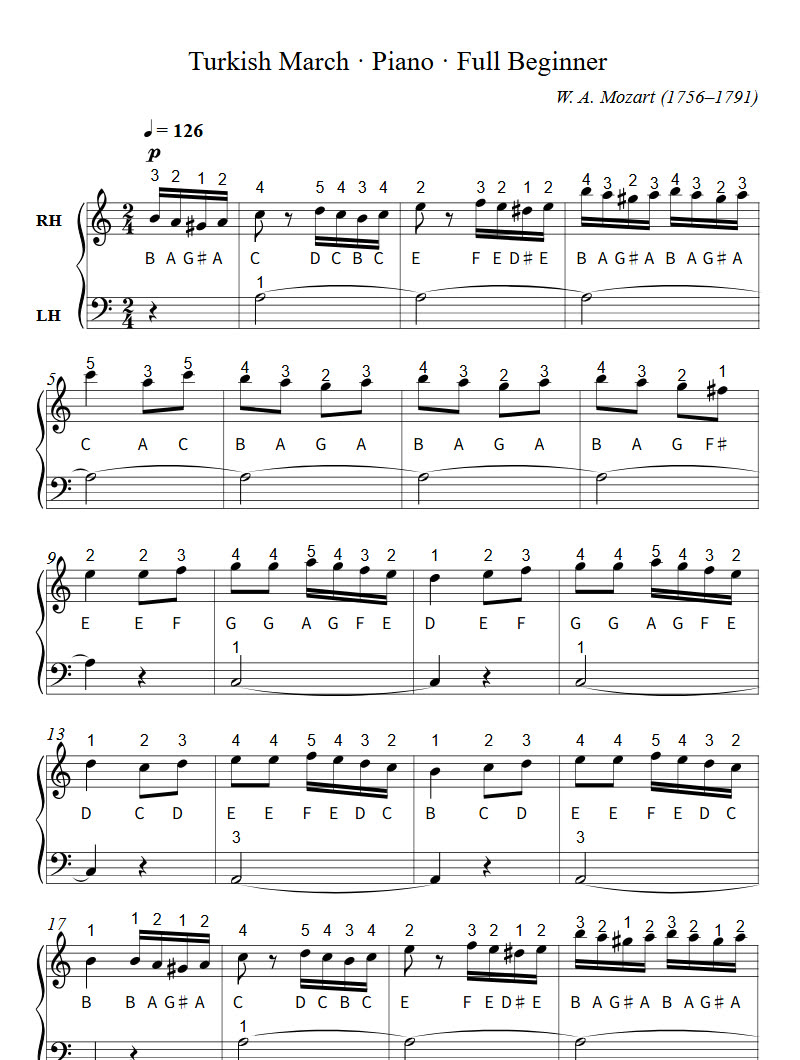 W. A. Mozart (1756–1791)
Turkish March
Its bright marching rhythm makes it a recital favorite. The beginner version is arranged so your fingers don't tangle.
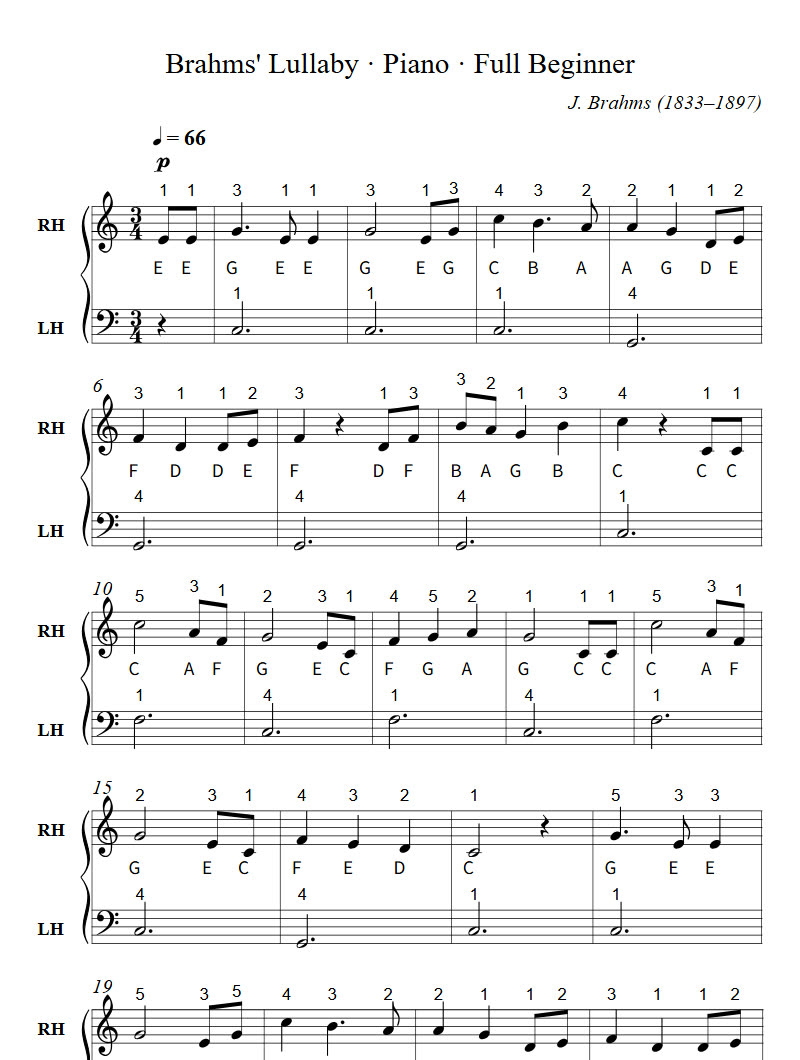 J. Brahms (1833–1897)
Brahms' Lullaby
Brahms' lullaby. Its slow three-beat lines are good practice for playing long, connected notes.
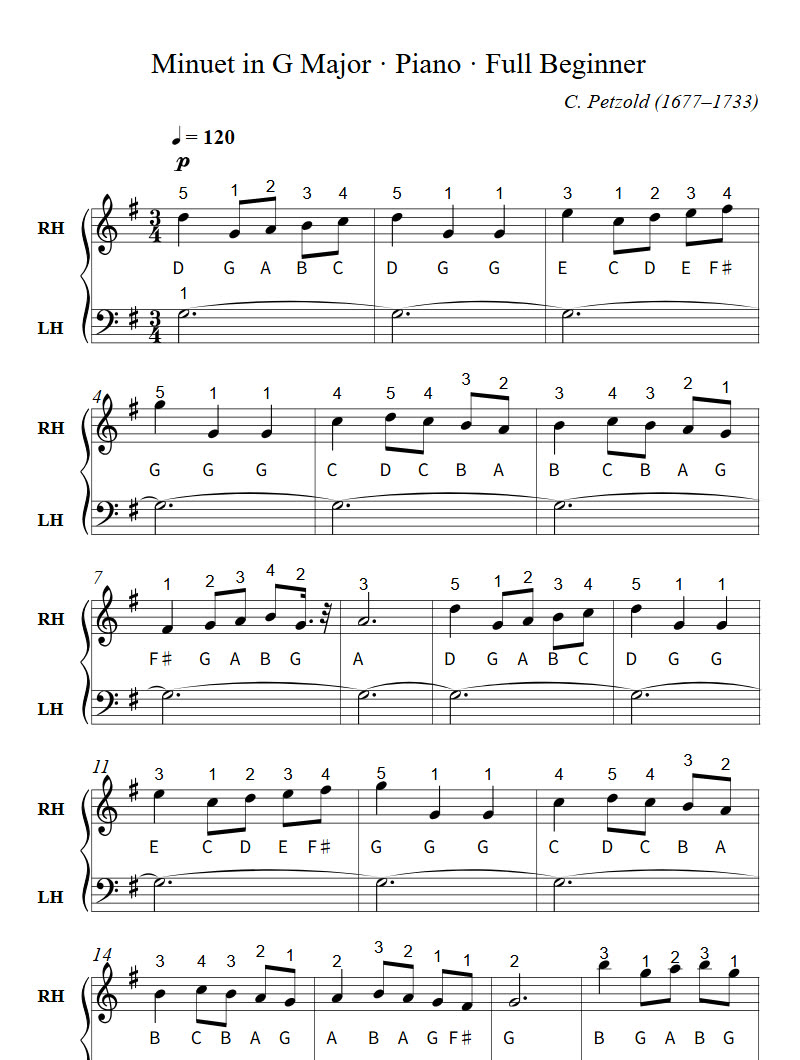 C. Petzold (1677–1733)
Minuet in G
The minuet from the Notebook for Anna Magdalena Bach — a piece every piano student meets.
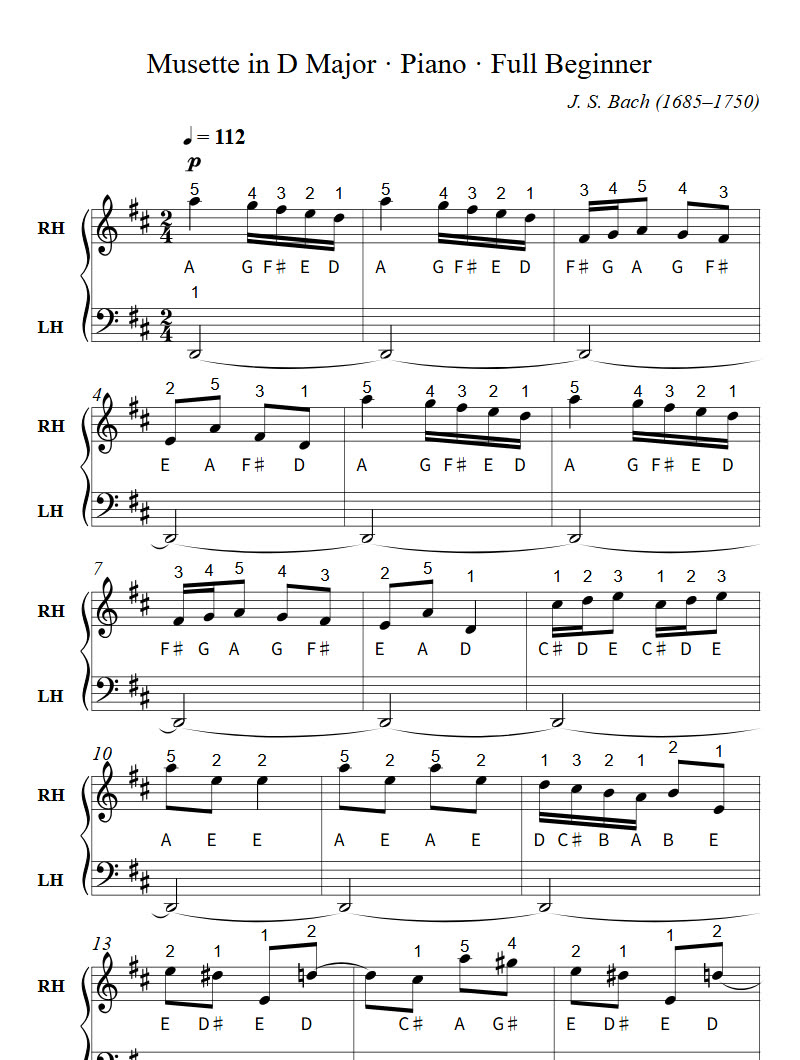 J. S. Bach (1685–1750)
Musette in D
A short piece from the Notebook for Anna Magdalena Bach. The left hand leaps between octaves.
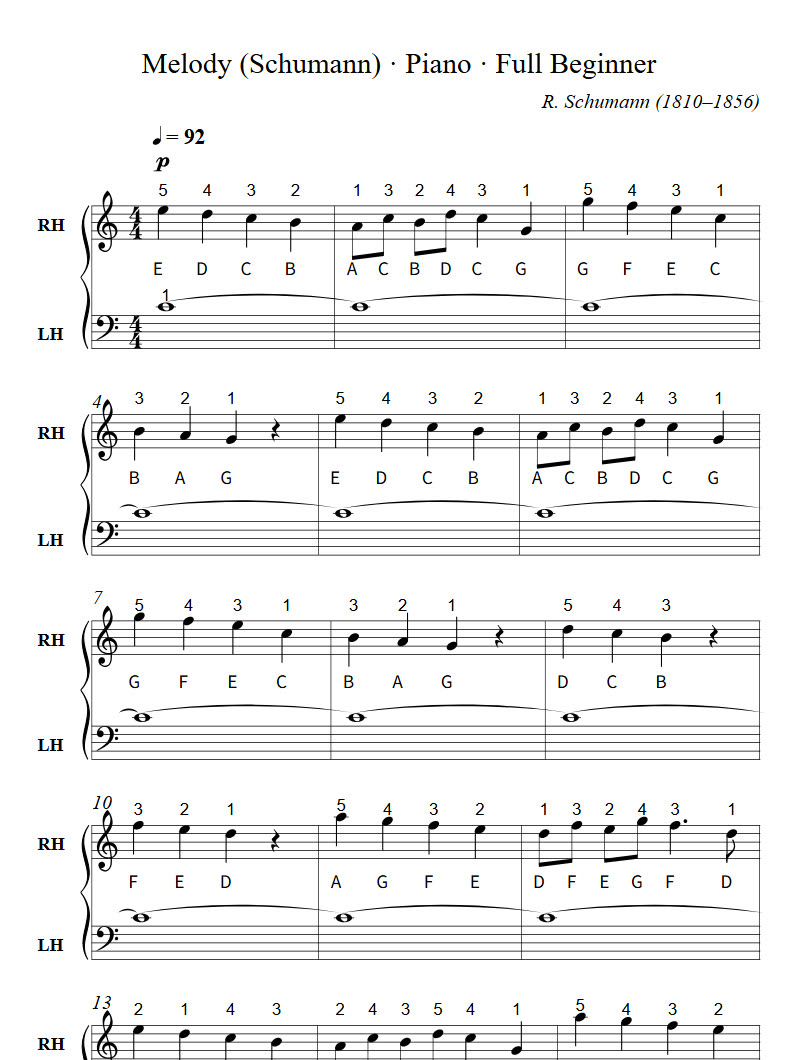 R. Schumann (1810–1856)
Melody (Schumann)
No. 1 from Schumann's 'Album for the Young'. Play the right-hand melody as if singing.
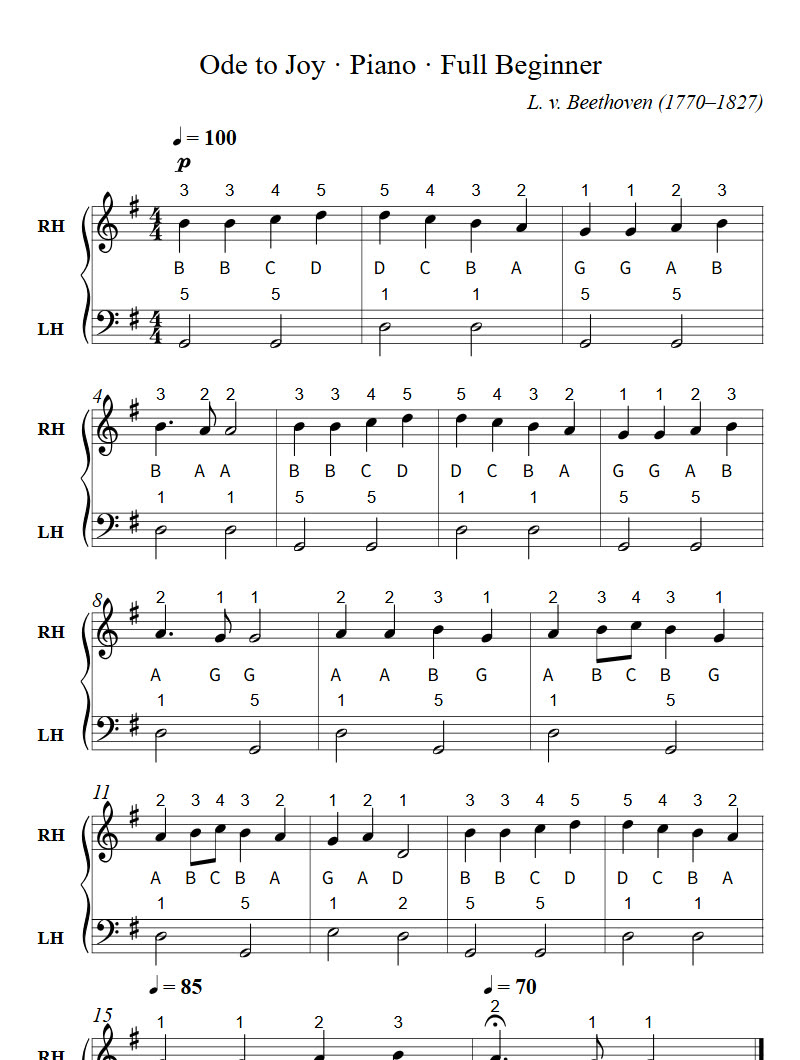 L. v. Beethoven (1770–1827)
Ode to Joy
The theme from the finale of Beethoven's Ninth. The notes move mostly step by step, so it's easy to learn first.
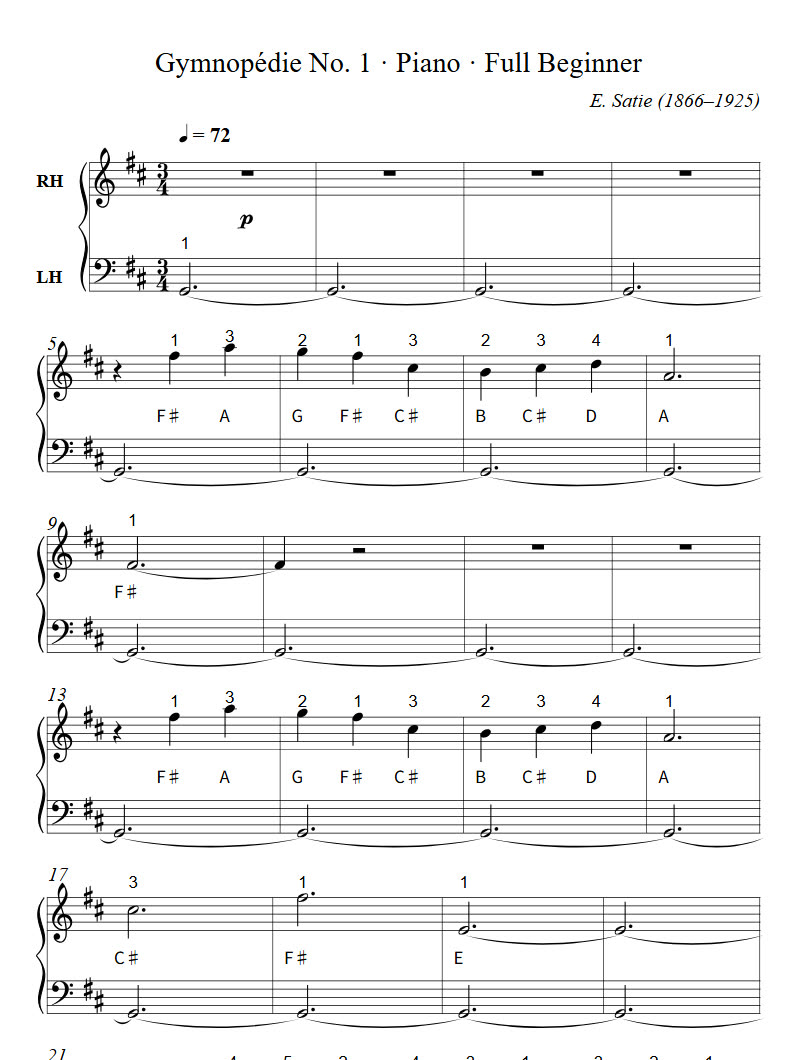 E. Satie (1866–1925)
Gymnopédie No. 1
Satie's slow, calm piano piece. The melody drifts gently over the left-hand accompaniment.
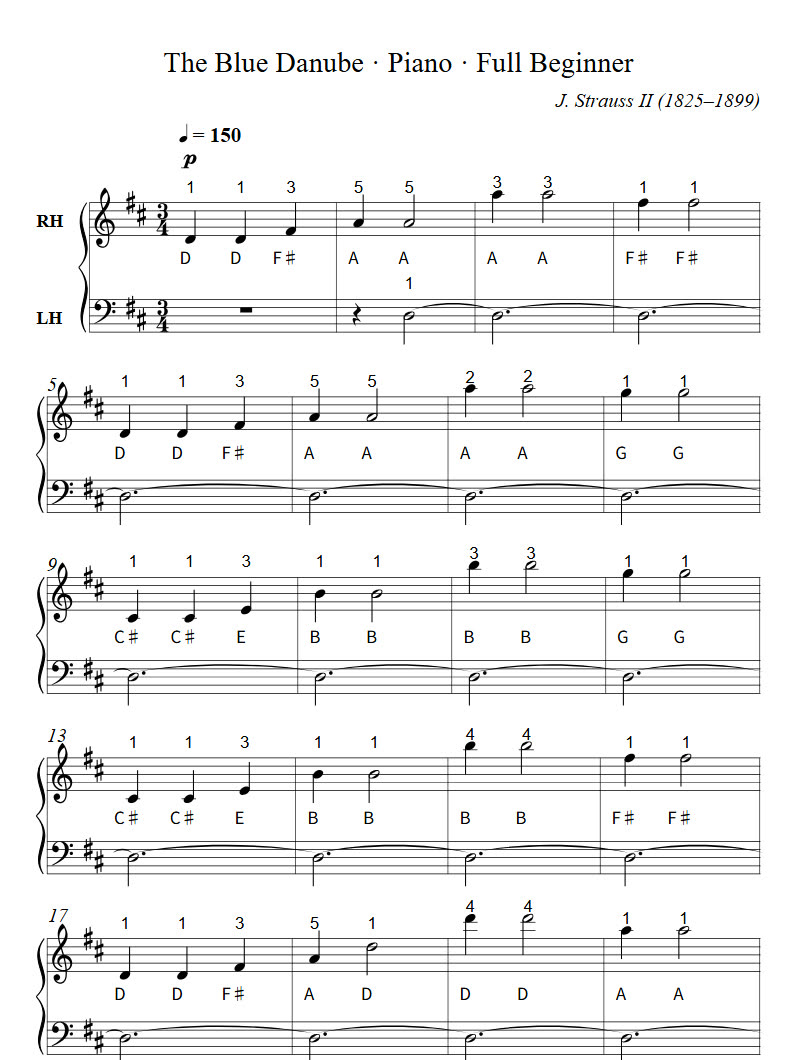 J. Strauss II (1825–1899)
The Blue Danube
The waltz theme by Johann Strauss II, often heard at year-end concerts.
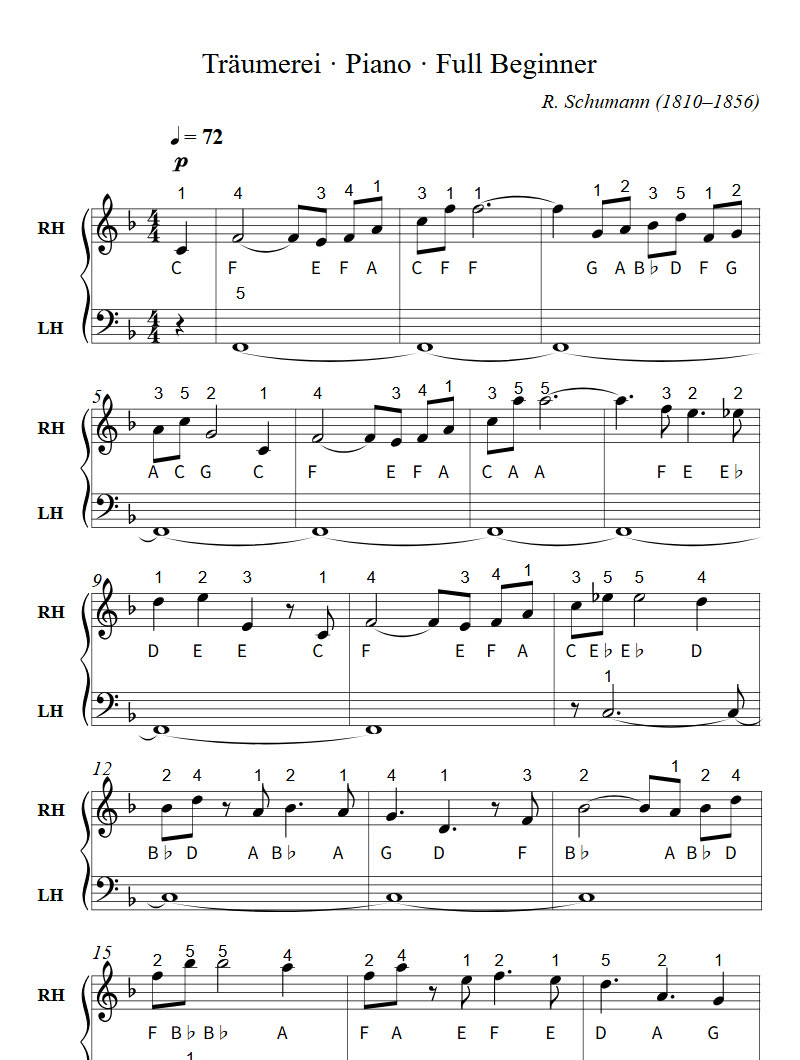 R. Schumann (1810–1856)
Träumerei
No. 7, 'Dreaming', from Schumann's 'Scenes from Childhood', with interweaving inner voices.
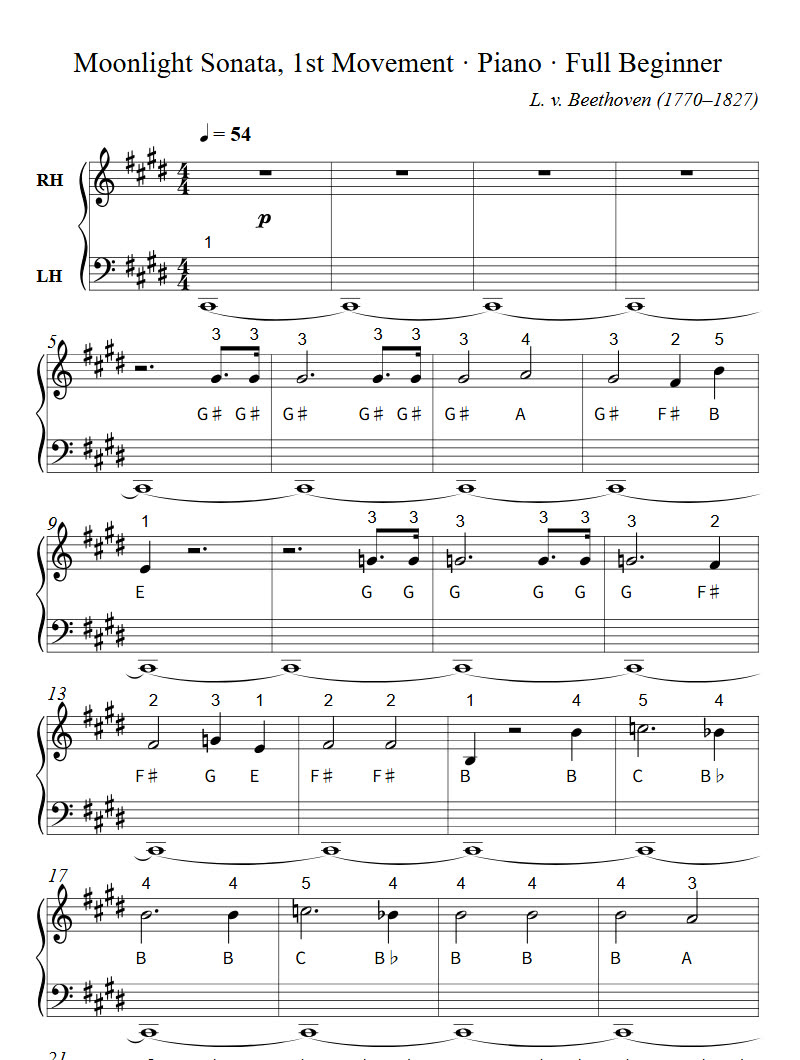 L. v. Beethoven (1770–1827)
Moonlight Sonata
The first movement of Beethoven's Piano Sonata No. 14. A slow melody floats over triplet accompaniment.
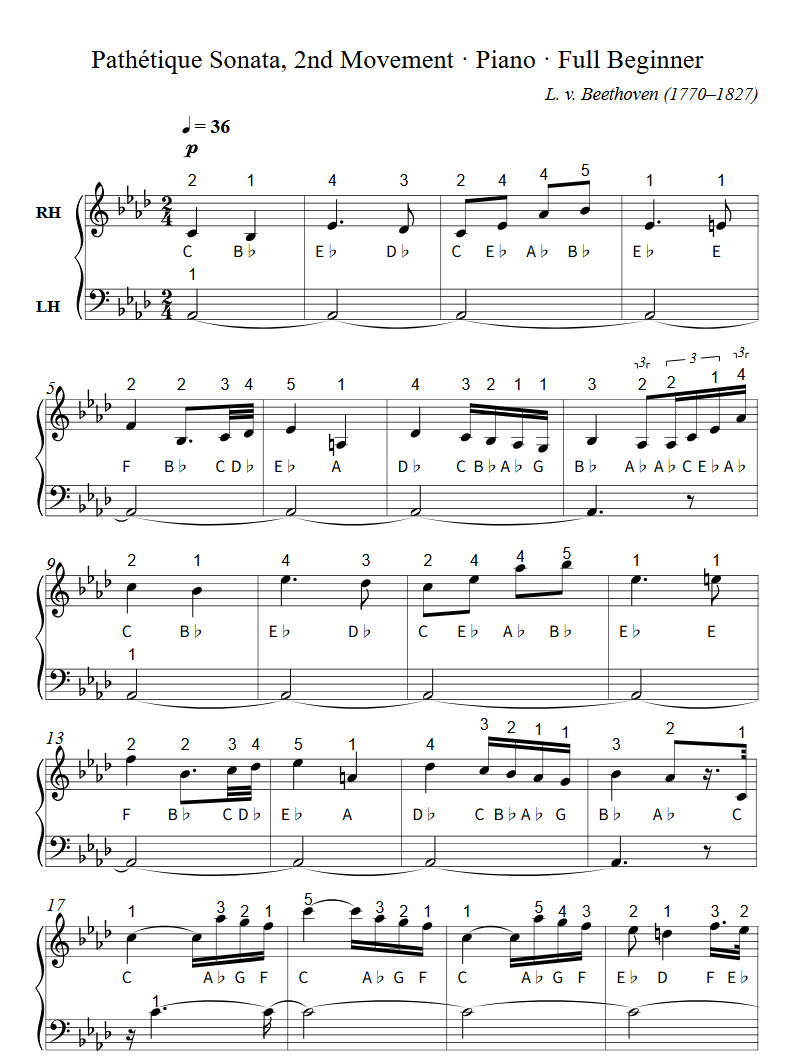 L. v. Beethoven (1770–1827)
Pathétique, 2nd Mvt.
The second movement of Beethoven's Piano Sonata No. 8. The theme returns an octave higher the second time.
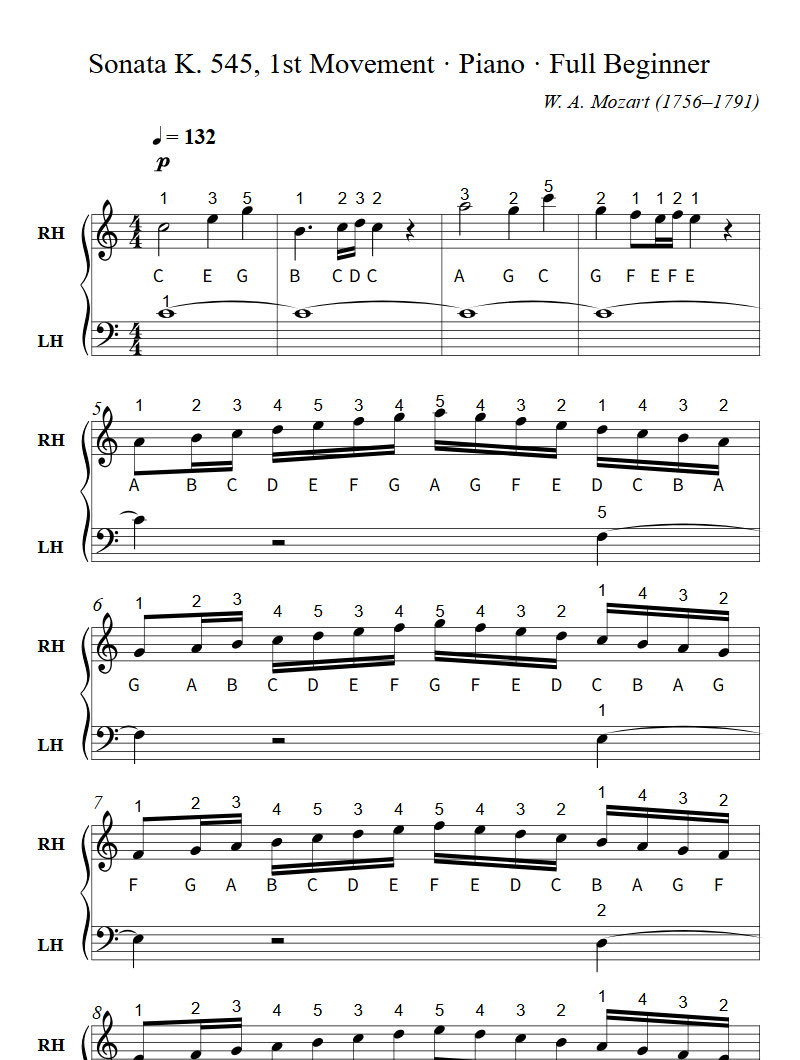 W. A. Mozart (1756–1791)
Sonata K. 545
Mozart's 'easy sonata': a C–E–G theme followed by quick scales.
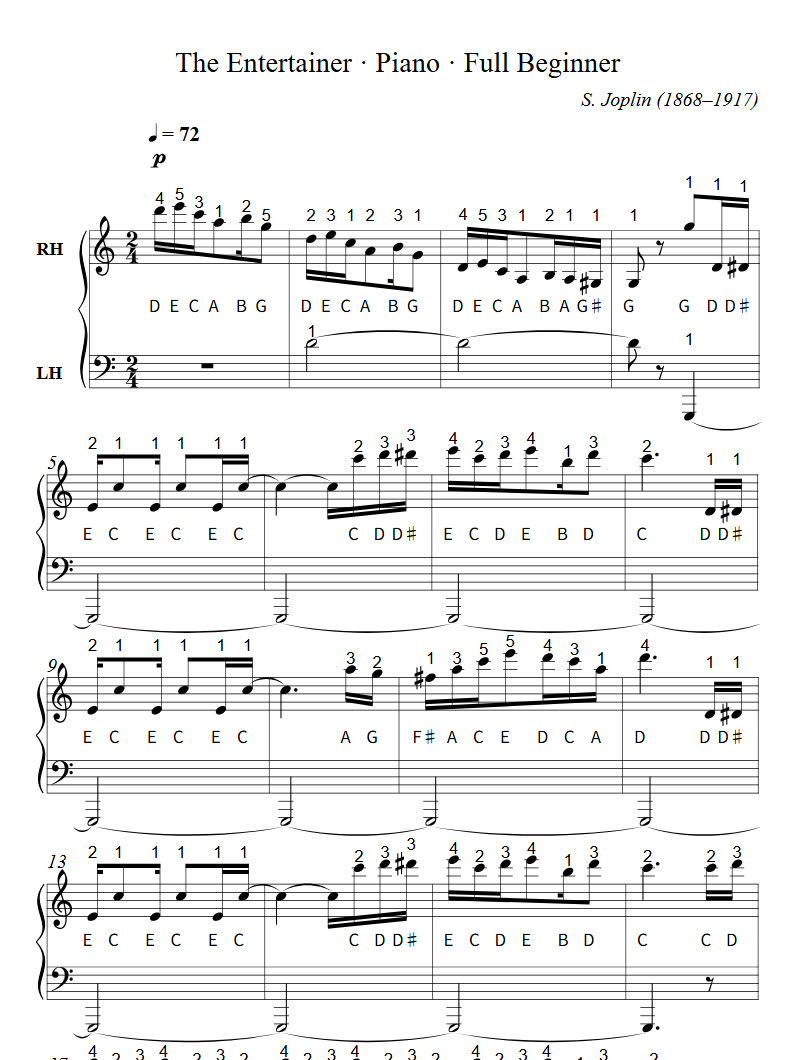 S. Joplin (1868–1917)
The Entertainer
Scott Joplin's ragtime, made famous again by the film 'The Sting'.
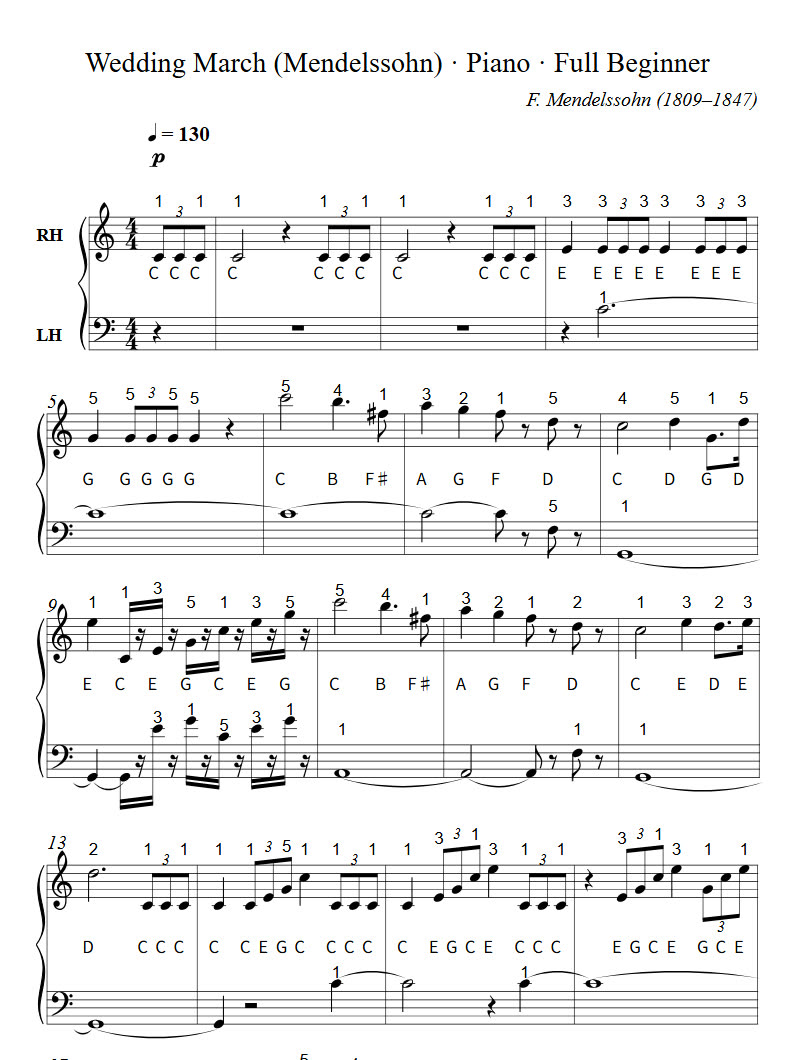 F. Mendelssohn (1809–1847)
Wedding March
Mendelssohn's march for the recessional at weddings. It opens with a trumpet fanfare.
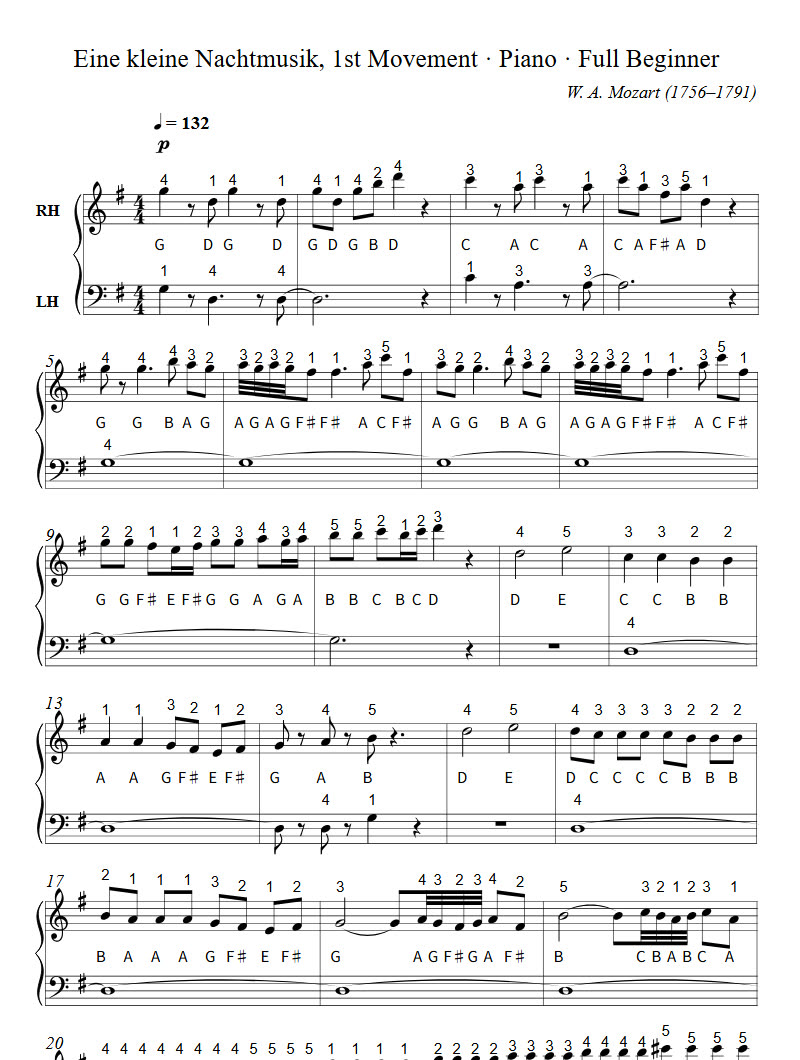 W. A. Mozart (1756–1791)
Eine kleine Nachtmusik
The first movement of Mozart's serenade. The original is for strings, so the piano left hand takes the cello part.
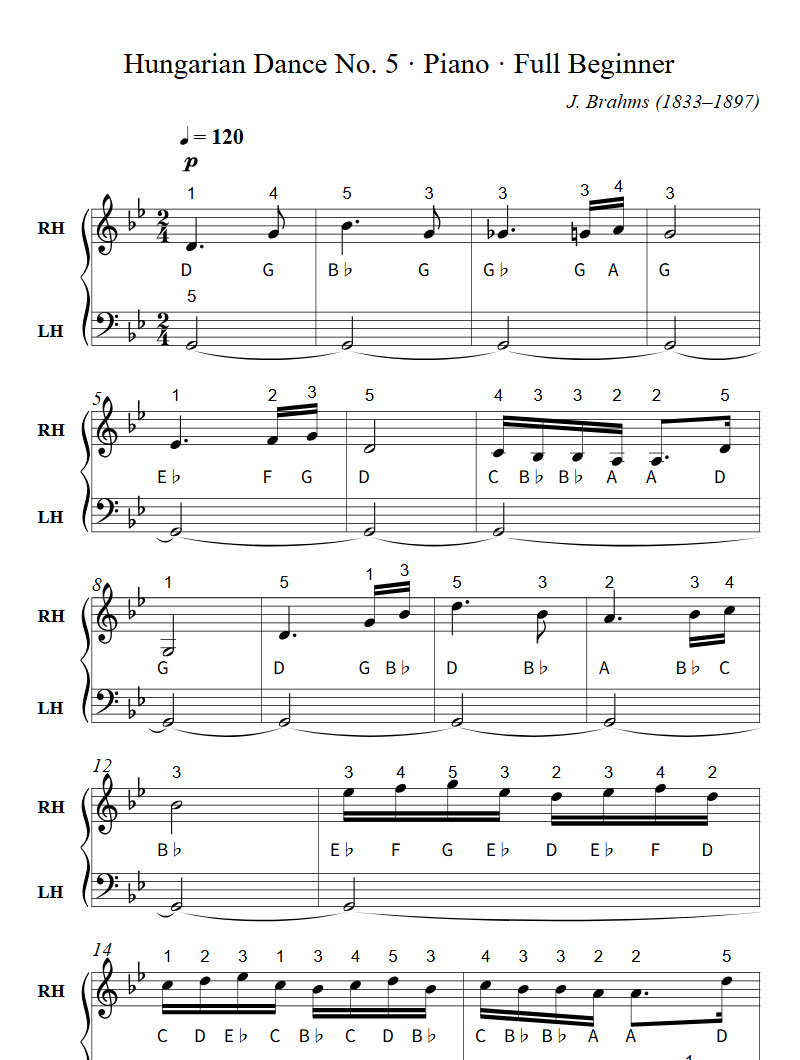 J. Brahms (1833–1897)
Hungarian Dance No. 5
Brahms' Hungarian Dance. Its gypsy-style rhythm slows down and speeds up.
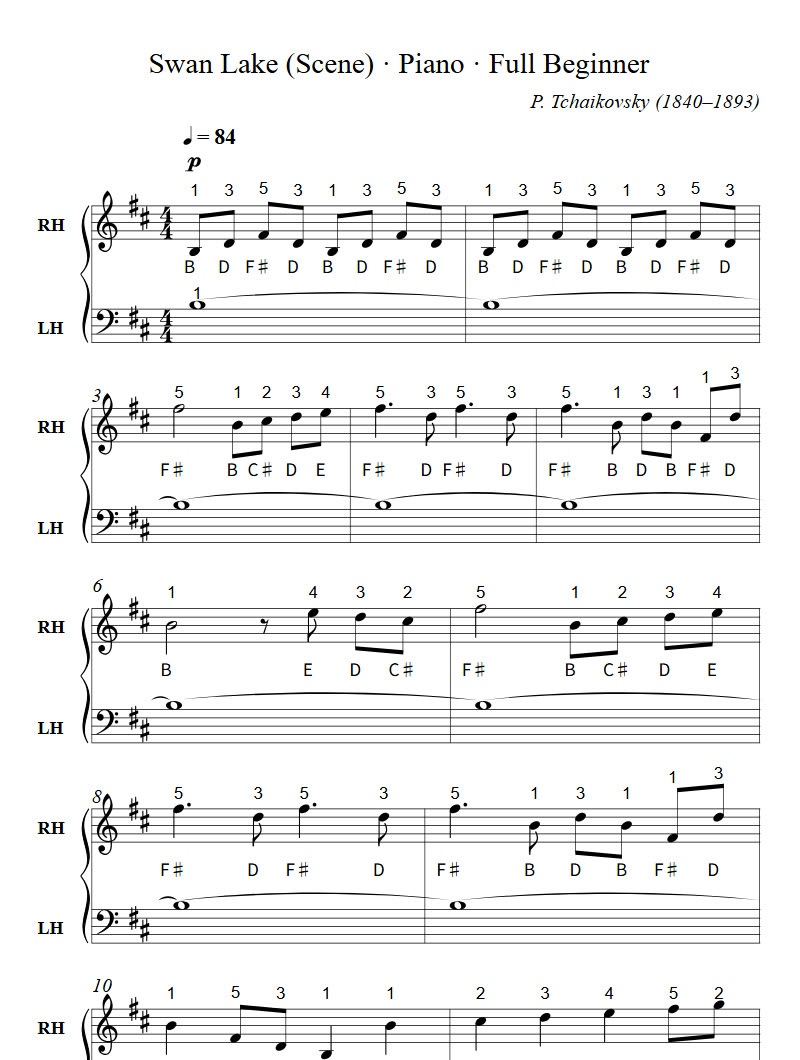 P. Tchaikovsky (1840–1893)
Swan Lake
The 'Scene' theme from Tchaikovsky's ballet Swan Lake — the lonely melody sung by the oboe.
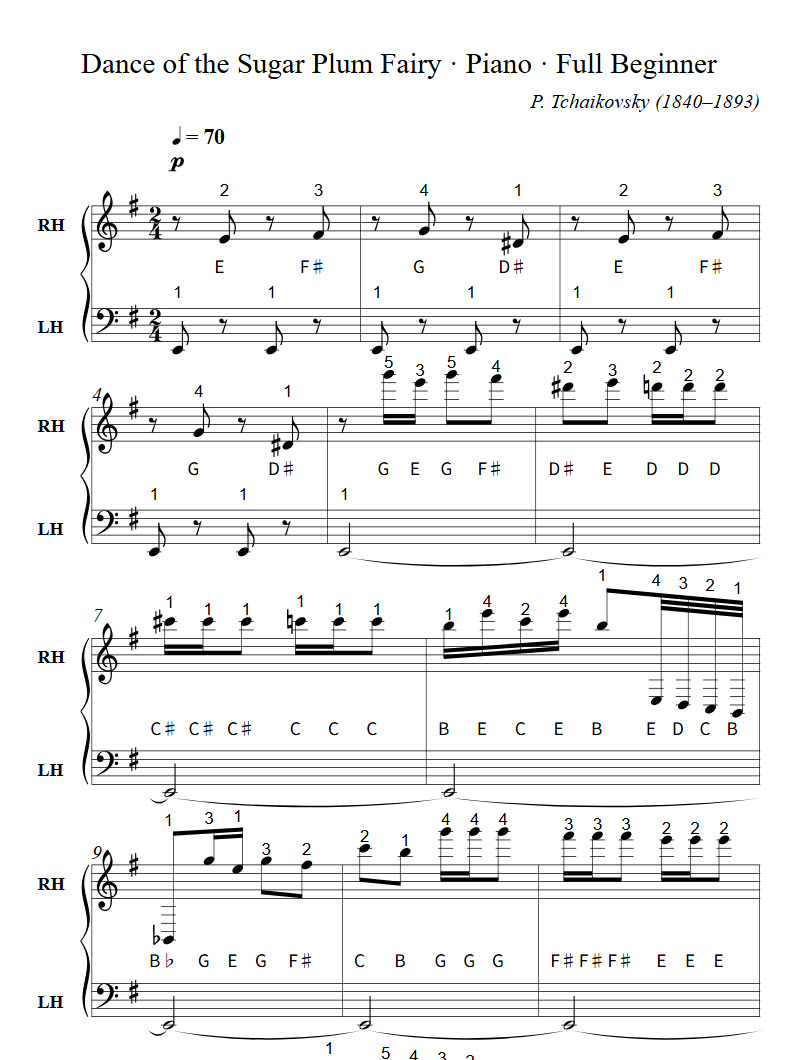 P. Tchaikovsky (1840–1893)
Sugar Plum Fairy
The celesta piece from The Nutcracker. Melody instruments are written an octave lower, like a celesta part.
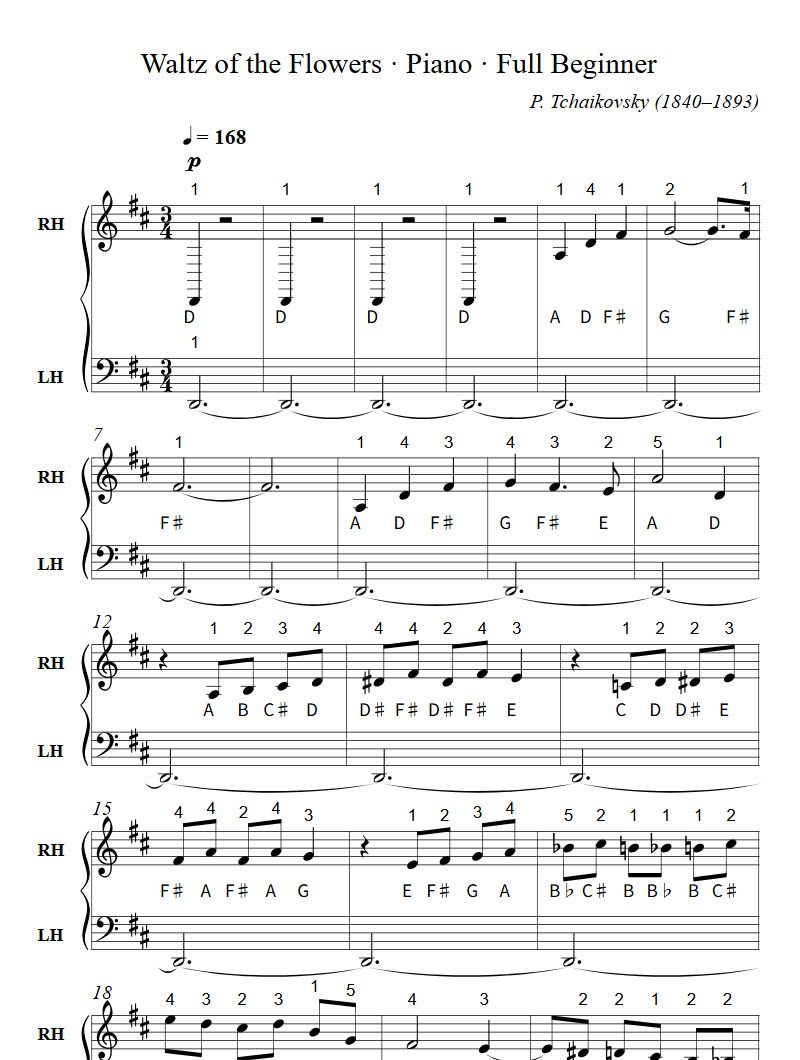 P. Tchaikovsky (1840–1893)
Waltz of the Flowers
The waltz from The Nutcracker, a must at year-end ballet performances.
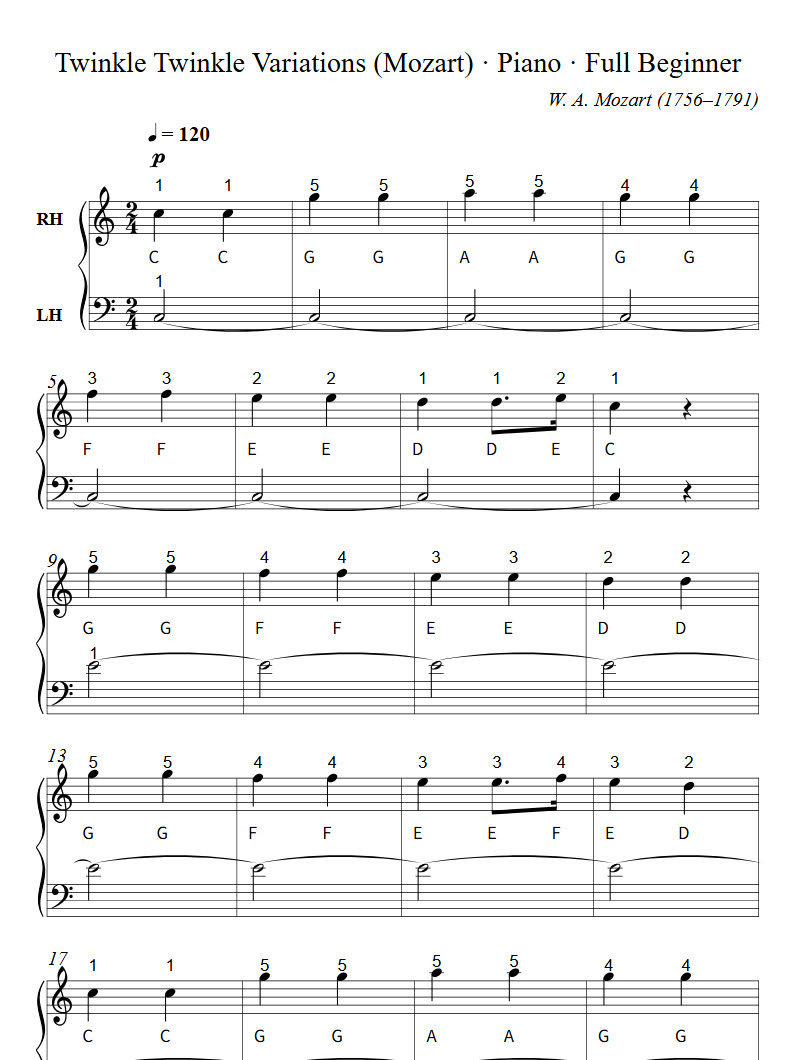 W. A. Mozart (1756–1791)
Twinkle Variations
Mozart's variations on the 'Twinkle, Twinkle' tune: the theme plus 11 variations.
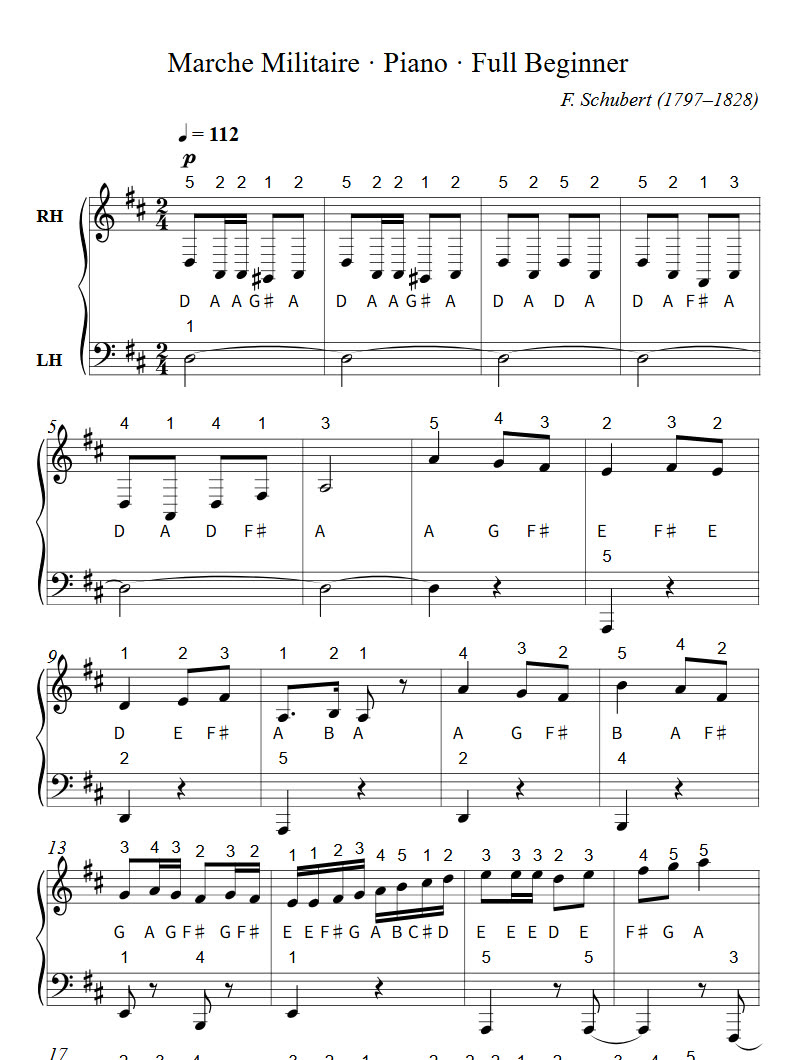 F. Schubert (1797–1828)
Marche Militaire
Schubert's march. The original is a piano duet, gathered here for two hands so you can play it alone.
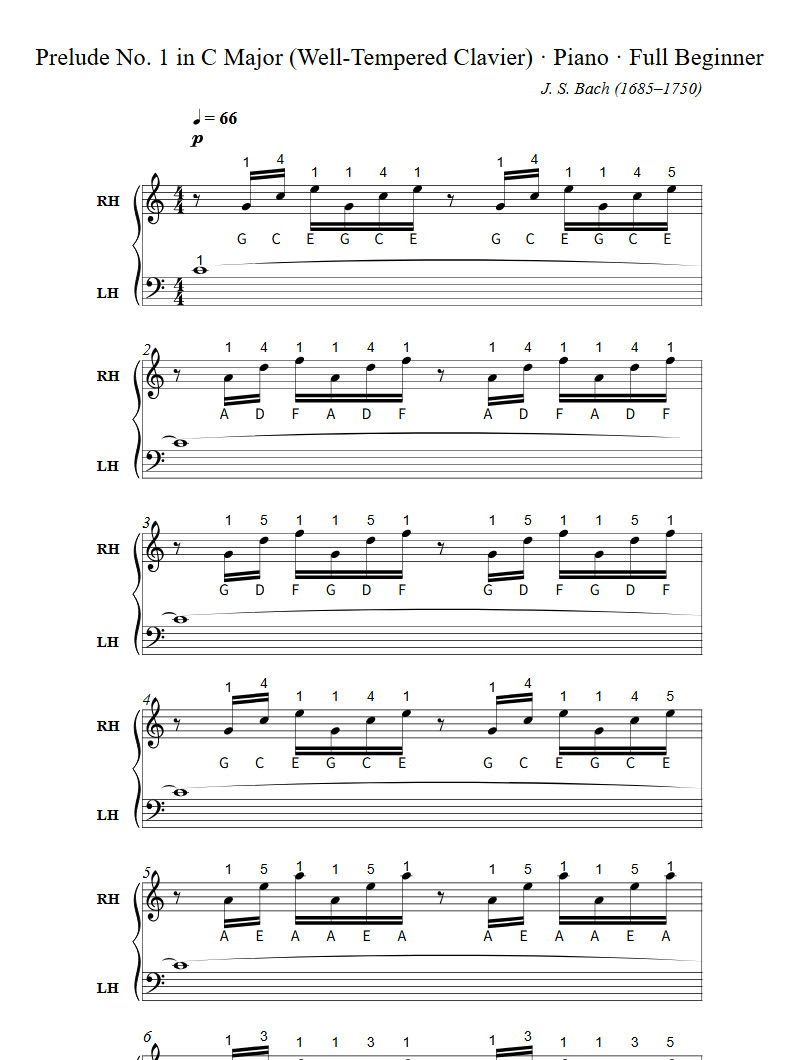 J. S. Bach (1685–1750)
Prelude in C
The first piece of Bach's Well-Tempered Clavier, Book 1. The same broken-chord pattern changes harmony bar by bar.
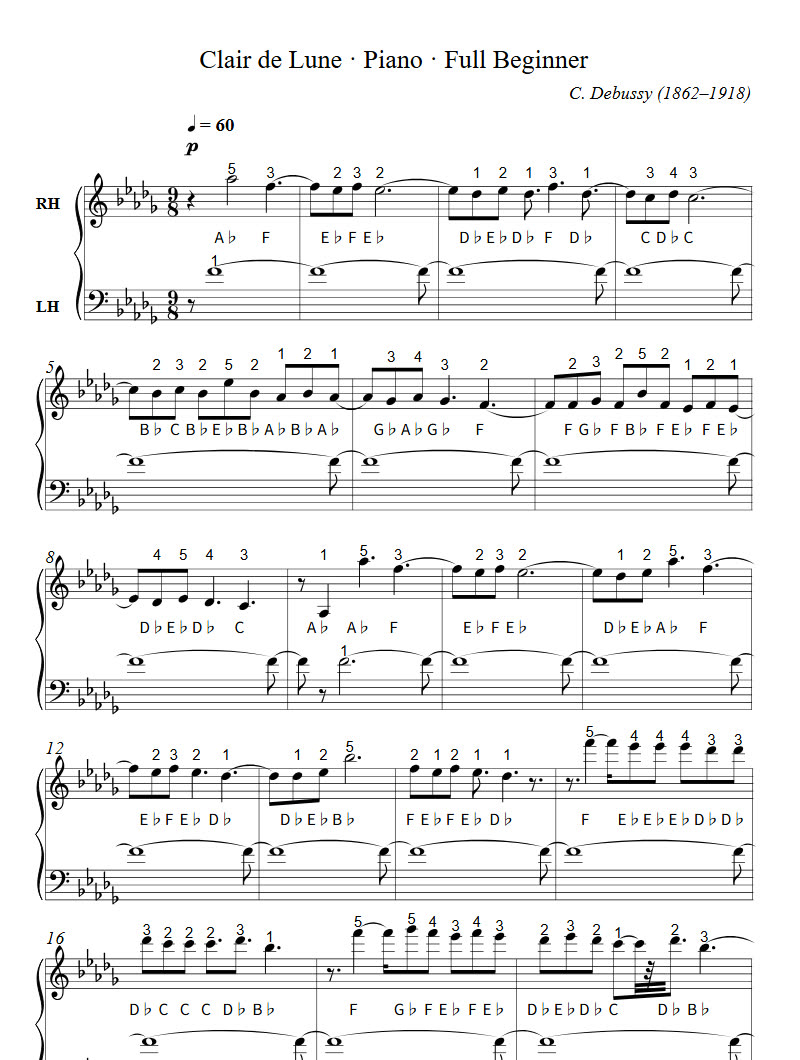 C. Debussy (1862–1918)
Clair de Lune
The third piece of Debussy's 'Suite bergamasque', flowing slowly in 9/8.
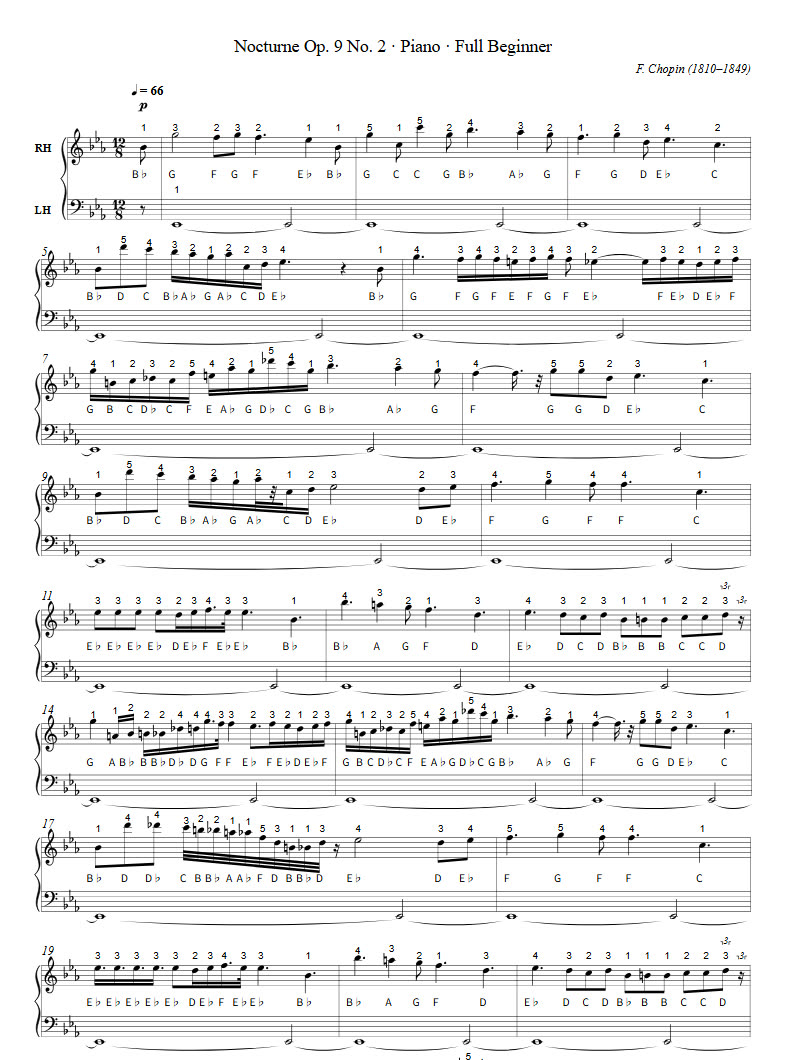 F. Chopin (1810–1849)
Nocturne Op. 9 No. 2
Chopin's best-known nocturne. A singing melody floats over a 12/8 accompaniment.
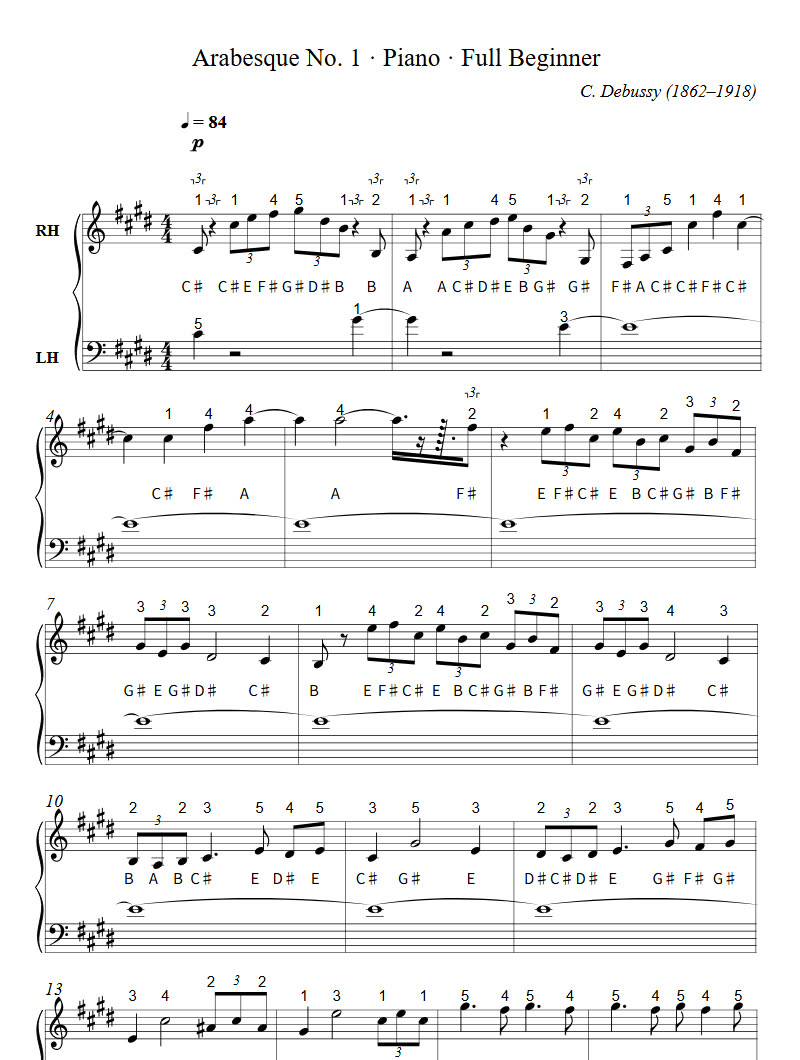 C. Debussy (1862–1918)
Arabesque No. 1
Debussy's piano piece, with triplet arpeggios rising and falling like waves.
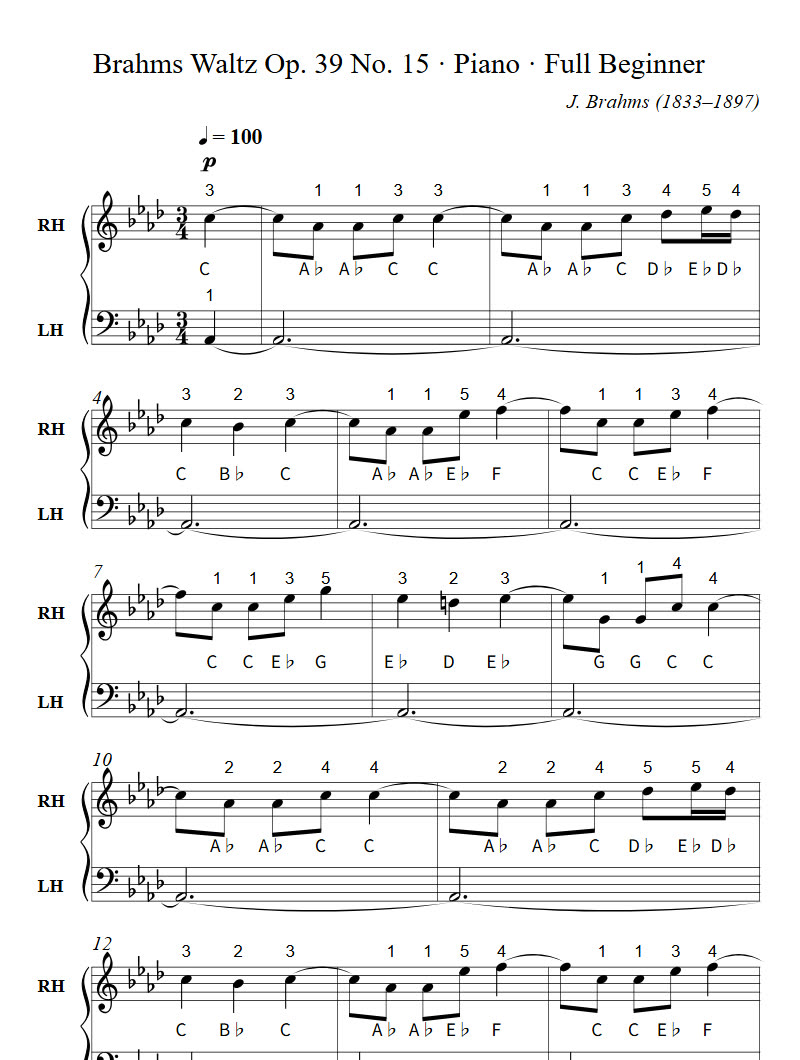 J. Brahms (1833–1897)
Brahms Waltz
No. 15, the most famous of Brahms' Waltzes Op. 39.
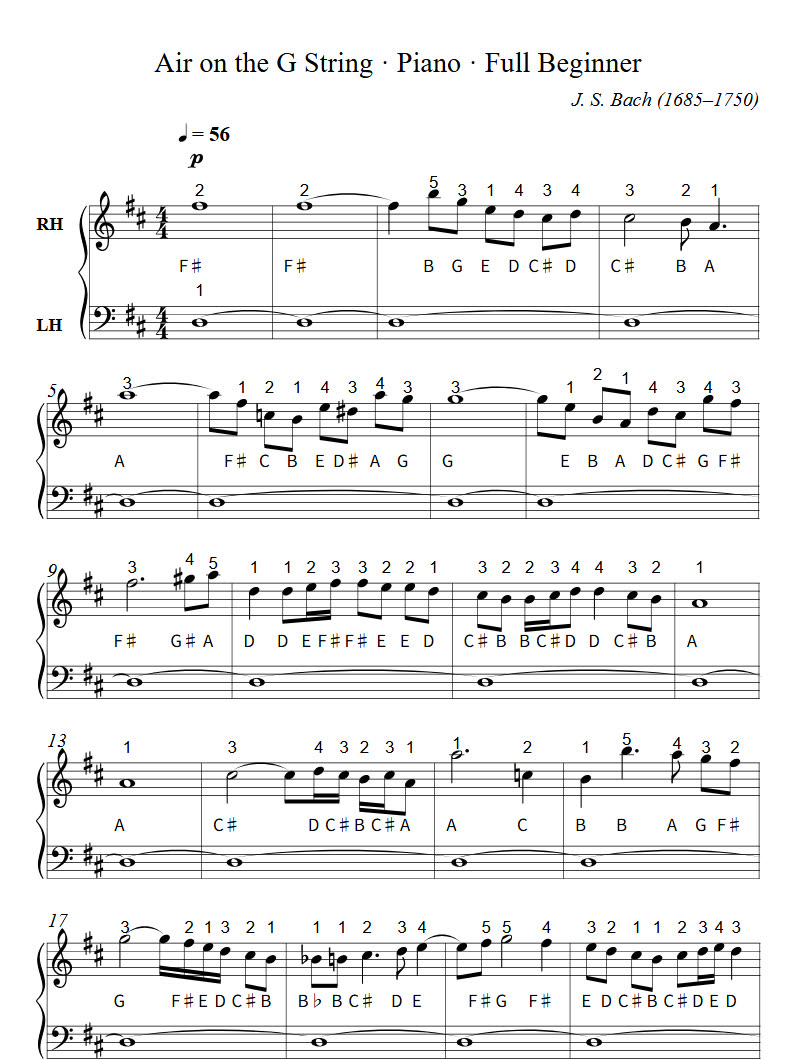 J. S. Bach (1685–1750)
Air on the G String
The Air from Bach's Orchestral Suite No. 3, taken from a piano arrangement in G major.
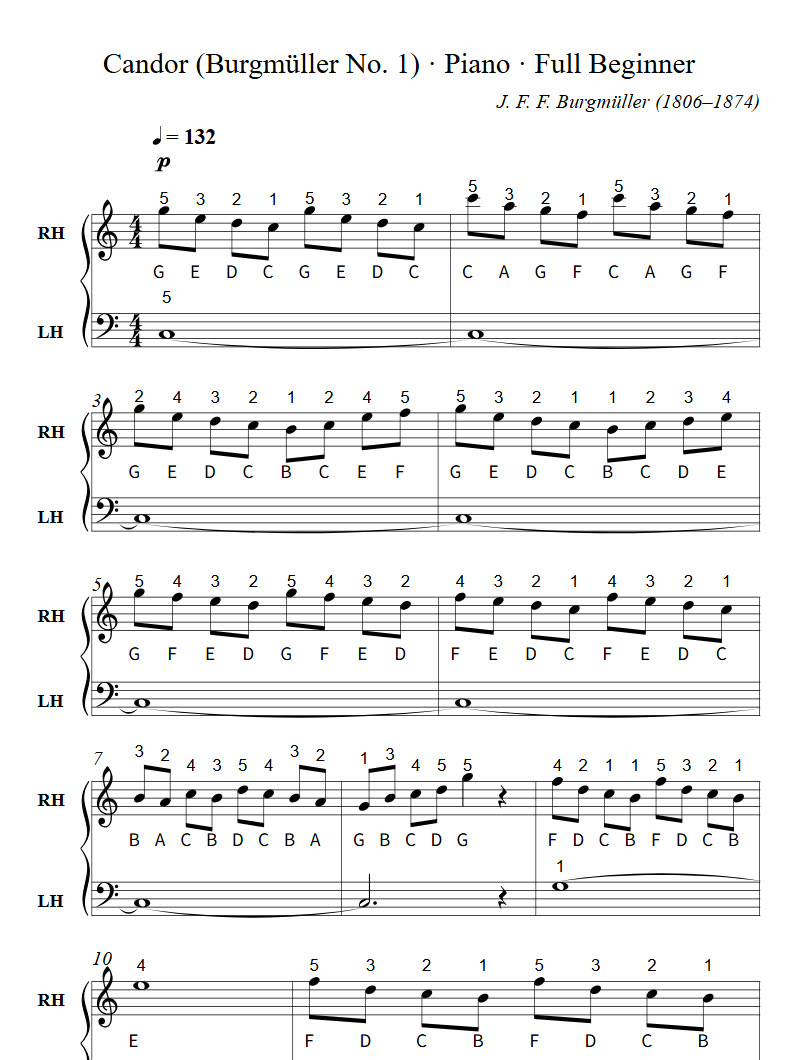 J. F. F. Burgmüller (1806–1874)
Candor (Burgmüller)
No. 1 of Burgmüller's 25 Easy Études — a piece many students play alongside Czerny.
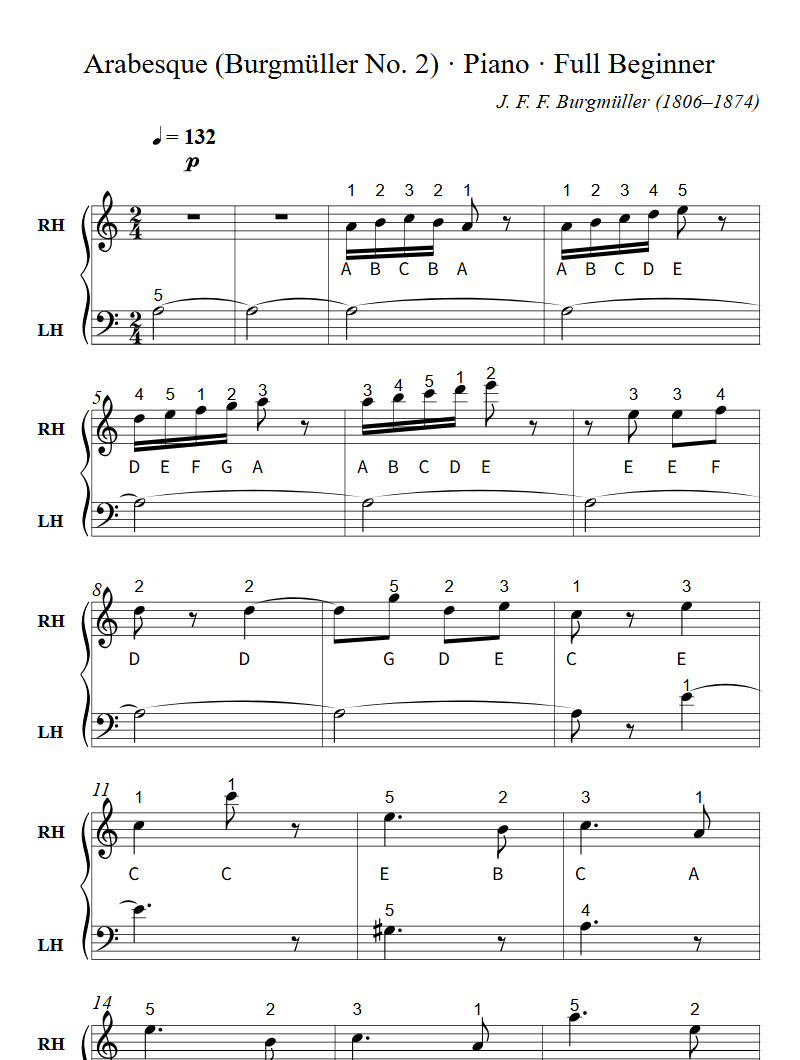 J. F. F. Burgmüller (1806–1874)
Arabesque (Burgmüller)
No. 2 of Burgmüller's 25 Easy Études — a recital favorite with fast rolling sixteenth notes.
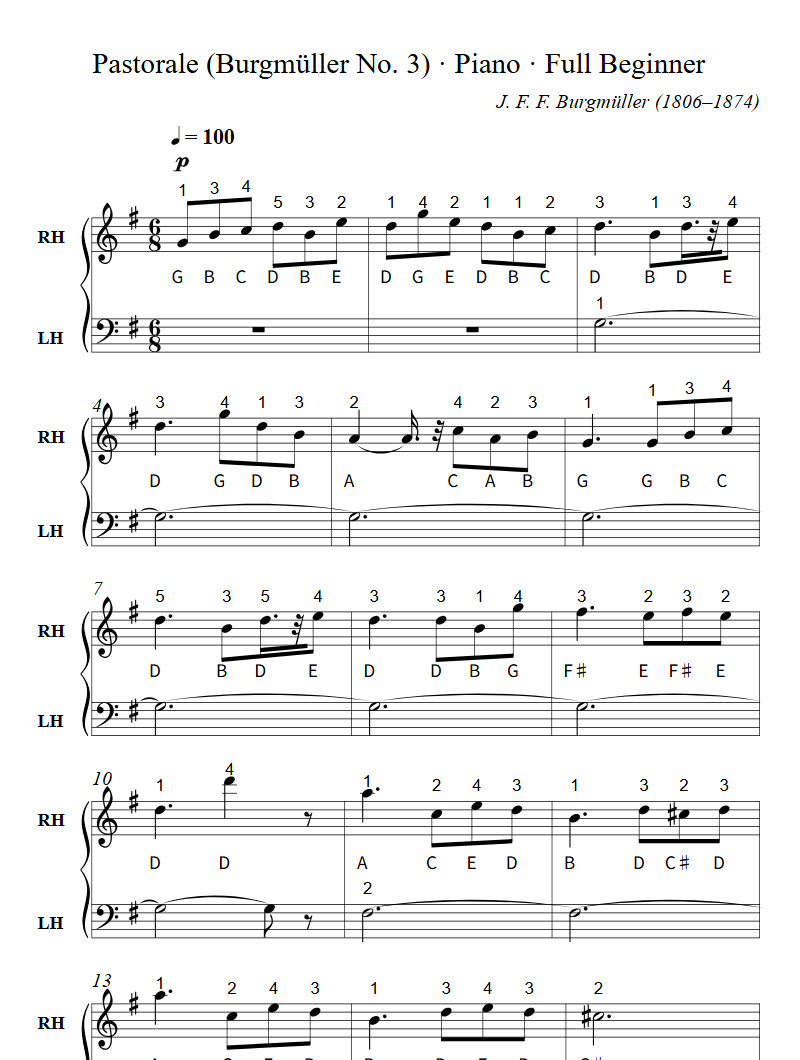 J. F. F. Burgmüller (1806–1874)
Pastorale (Burgmüller)
No. 3 of Burgmüller's 25 Easy Études, in 6/8, evoking open fields.
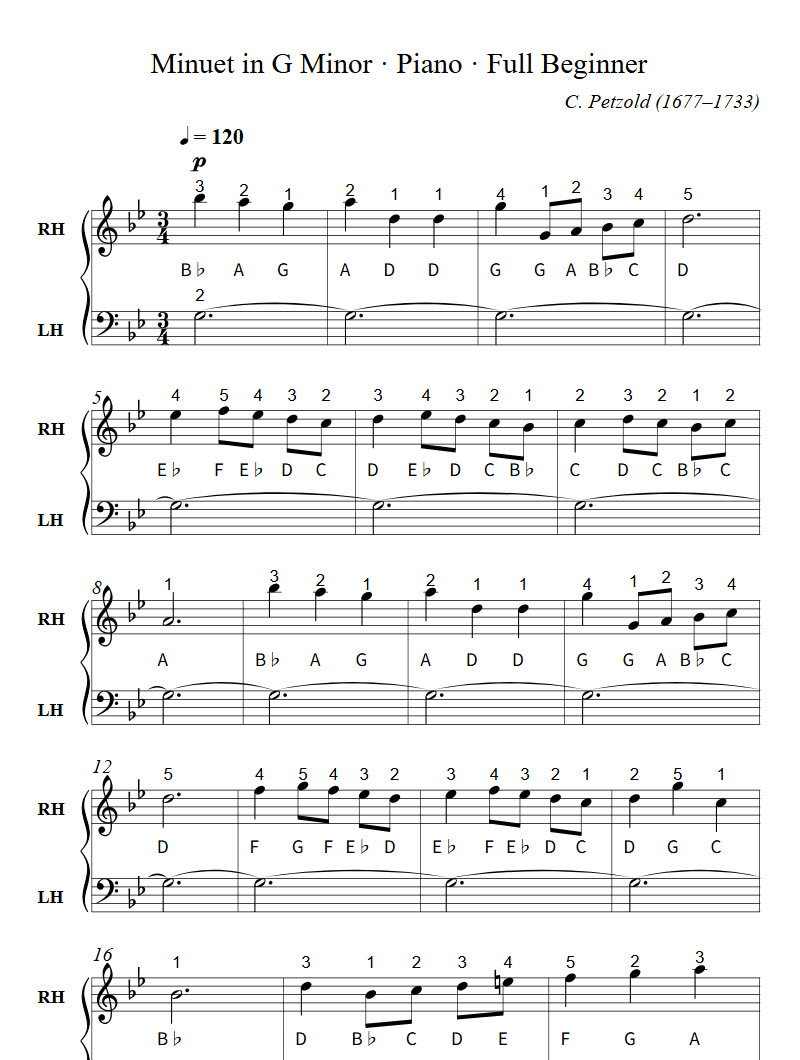 C. Petzold (1677–1733)
Minuet in G Minor
The minor-key minuet from the Notebook for Anna Magdalena Bach, often paired with the Minuet in G.
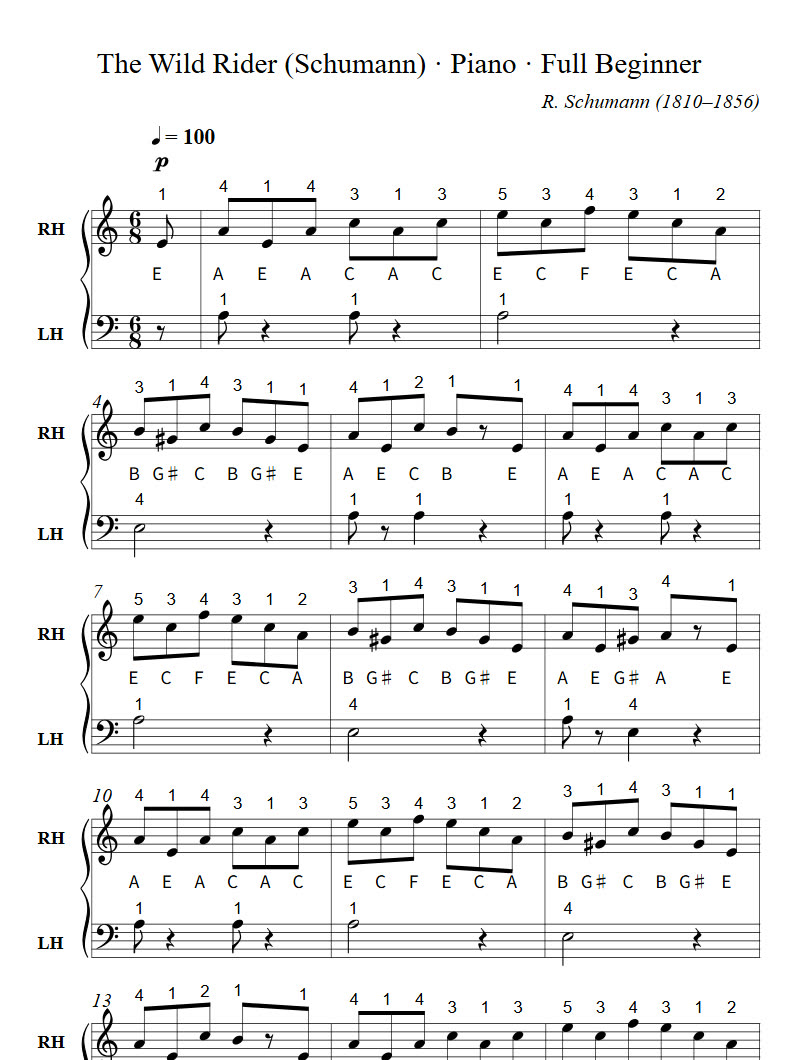 R. Schumann (1810–1856)
The Wild Rider
No. 8 from Schumann's 'Album for the Young'. Play it short and strong, like a galloping horse.
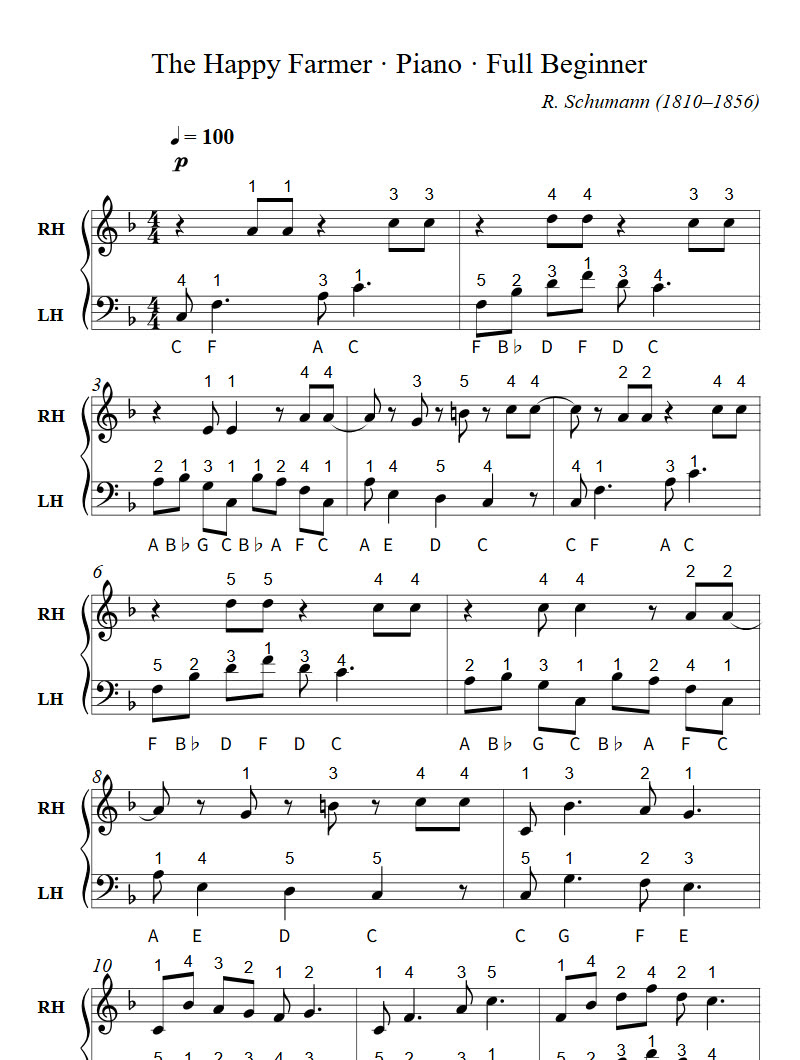 R. Schumann (1810–1856)
The Happy Farmer
No. 10 from Schumann's 'Album for the Young'. The left hand sings the melody while the right hand supports with chords.
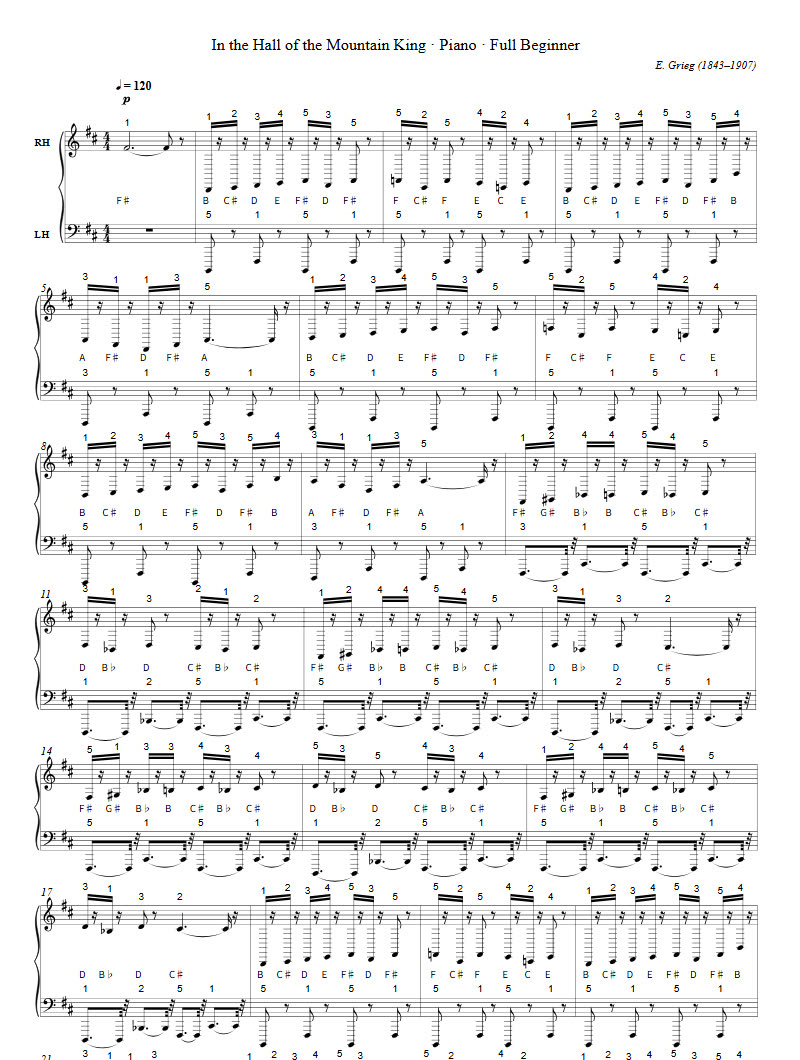 E. Grieg (1843–1907)
Hall of the Mountain King
From Grieg's 'Peer Gynt'. The same melody gets faster and louder.
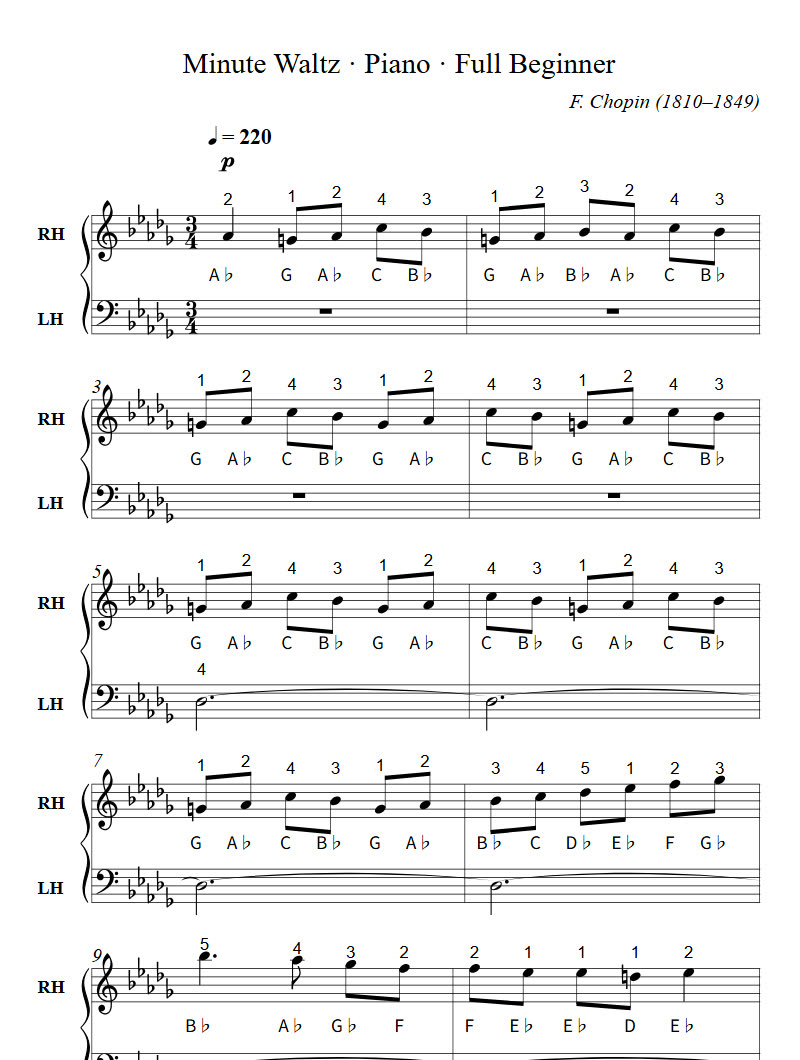 F. Chopin (1810–1849)
Minute Waltz
Chopin's 'Minute Waltz', said to picture a little dog chasing its own tail.